Which technology to use? It’s a gamble

How do you choose which technology to invest in? If you lead a technology team, it is the platform and the vendor. If you write software, it is the language and framework. If you are building a career, it is the vendor training and certifications you will spend your evenings on.
It is the same question in three costumes, and in a fast-moving industry the honest answer is uncomfortable – it is a gamble. You can improve the odds, but you cannot remove the risk. This article looks at why the safe bet keeps changing, shares a few of my own scars, and then suggests how to make the gamble smaller.
Better is not always the victor
History is littered with stories of a technology that looked better on paper losing to a competitor. The technically superior, most popular or most heavily promoted option at one point in time often does not become the long-term standard.
The classic example is the 1980s videotape format war. Betamax is often remembered as the better format that lost to VHS. The truth is more interesting. Betamax had a slight edge in picture quality, but early tapes recorded only about an hour, while VHS offered two, enough for a whole film or a football match. Sony stretched Betamax to two hours, but at the cost of the quality advantage. VHS also had broader licensing, so more manufacturers made players, more shops stocked tapes and more rental titles appeared on the format. Betamax won on one measure. VHS won on the measures that mattered to buyers.
The high-definition disc war repeated the pattern. Between 2006 and 2008, Blu-ray and HD DVD fought for the market, and the contest turned on who had the studios and retailers behind them. When Warner Bros. dropped HD DVD in early 2008, other studios and retailers followed, and Toshiba announced on 19 February 2008 that it would stop making HD DVD players. If you had bought the losing player and the discs to go with it, you were left with an expensive ornament.
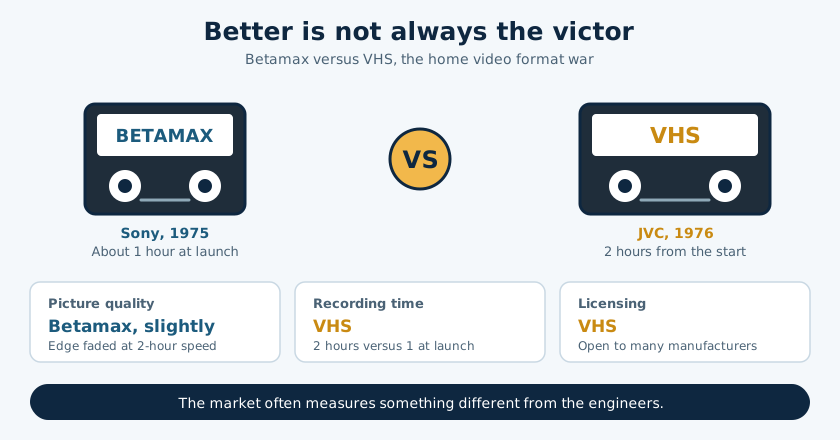
The lesson is that “better” depends on who is measuring, and the market often measures something different from the engineers.
My war story: a certification I never finished
Early in my career, in the mid 1990s, I was hungry for training and skills. I looked at the industry and chose the market leader and de-facto standard for file and print servers: Novell NetWare. The path to becoming a Certified Novell Engineer was long. It meant 12 training courses and 14 exams.
After my 13th exam, my employer told me they were switching from NetWare to Microsoft Windows NT.
I never finished the certification, and I never worked with NetWare again. Overnight I was inexperienced and unqualified for my own job, and worse off in the job market than before. All that study and investment was obsolete, and I had to decide where to point my studies next. That was when I realised it is a gamble whichever direction you take.
It is also a good example of the pattern. NetWare did not fail because it was a poor product. It had once held a majority share of the network operating system market, and it began losing ground once Microsoft bundled network services into Windows NT. The market moved, and my employer moved with it.
The mobile phone wars, and the debt they leave behind
The mobile market of the 1990s and early 2000s offered a bewildering choice of handsets, and a different charging connector for nearly every one. BlackBerry later became the business standard. According to Gartner figures reported by MacRumors, BlackBerry’s share of smartphone operating systems grew from 9.6% in 2007 to 19.9% in 2009. Then the decline began, first to the iPhone and then to Android, until BlackBerry’s share rounded to zero.
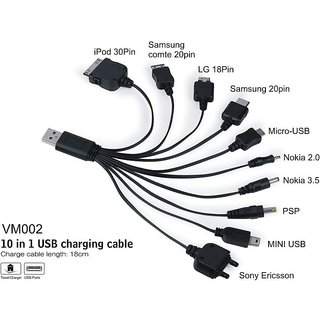
If you had a mobile phone in the 1990s, you will know the huge range of phone charging connectors, and if you had more than one phone in that era, you may even have a drawer or box of old connectors or adapters – investment in a now obsolete technology.
For a business, each of these platforms comes with its own way of being managed and supported. Many organisations had already put money into management software, accessories, apps and processes for the leading platform, and some chose to keep pushing their staff towards it because it had been their decision. That investment becomes technology debt: the longer the change is left, the more it costs. It happens all the time, when significant investments are made and then the industry changes beneath them.
The day an organisation threw away a working mobile strategy
I saw a more human version of this while consulting. An organisation had recently finished rolling out an Android-based mobile device management system, 42Gears, to manage a couple of thousand devices. A new IT leader was hired. He had a personal dislike of Android, and declared that everyone would get an iPhone.
All the work and investment was thrown away, because the management platform did not support iOS devices at that time. Years later I heard that the change had caused further problems, because some enterprise applications were not supported on iPhone, and some staff had to be moved back to Android. It was a very expensive exercise, though it did earn a lot of consultants a lot of money.
Notice that this was not really a technology decision. It was a preference, made without the evidence a technology decision needs.
Safe bets that stopped being safe
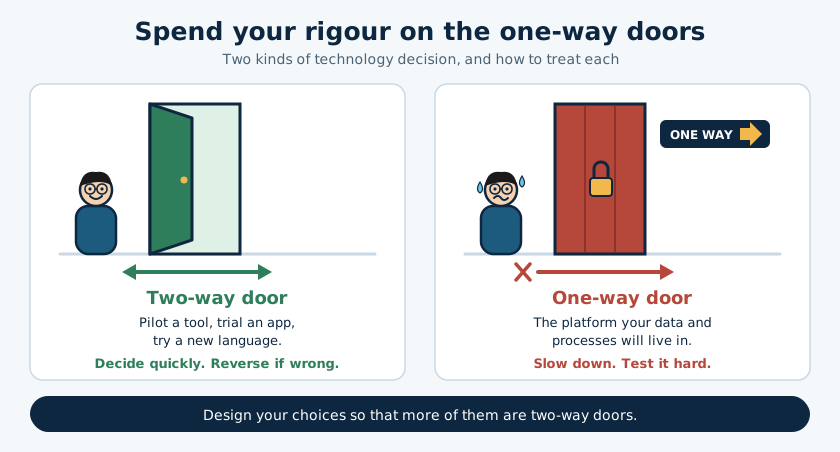
Betamax, Novell NetWare, BlackBerry, Skype and Visual Basic 6 were all considered safe bets at some point. Looking at what became of each is humbling.
| Technology | Once the safe bet | What happened |
| Betamax | The first home video format on the market in 1975 | Lost to VHS on recording time and licensing, with the last Betamax machine made in 2002. |
| Novell NetWare | The leading network operating system | Lost ground to Windows NT. General support ended on 7 March 2010, and the path forward was Open Enterprise Server on Linux. |
| BlackBerry | The business smartphone, with about a fifth of the smartphone market in 2009 | Overtaken by iPhone and Android. Its legacy services were switched off on 4 January 2022. |
| Skype | The service so popular it became a verb, bought by Microsoft in 2011 | Retired on 5 May 2025 as Microsoft focused on Teams. |
| Visual Basic 6 | A mainstay of Windows desktop applications in the late 1990s | The development environment has been unsupported since 8 April 2008, yet its runtime is still supported on Windows 11. |
Two things stand out. First, none of them vanished overnight. Most lingered for years, and VB6 is still lingering, which brings its own problem: an unsupported tool underneath a business-critical application. Second, the reasons were rarely technical. They were about ecosystems, economics, timing and decisions made by other companies, such as Microsoft choosing to focus on Teams.
The decision about what to do with a technology that is fading is the subject of my article on legacy modernisation.
Why it is so hard to predict
History shows that predicting the “best” technology is far harder than identifying today’s leader. The technologies that became standards often won because of things that have little to do with engineering quality:
- Ecosystems. People buy the platform with the most content, apps, accessories and skilled people. BlackBerry’s own financial filing put part of its decline down to consumer preference for devices with access to the broadest number of applications.
- Openness and licensing. VHS was made by many companies. Betamax stayed largely with one. Android was built by many manufacturers.
- Economics. Price, running costs and capacity often beat features.
- Timing. BlackBerry 10 launched in January 2013, nearly six years after the first iPhone. By then the ecosystem battle was over.
- Other companies’ decisions. A vendor can decide to merge, retire or change direction, as Microsoft did with Skype, and your investment goes with it.
- People. An executive’s personal preference, a hiring decision or a vendor relationship can override the evidence, as in the iPhone story above.
None of these can be forecast reliably, and some are not technical at all.
Making the gamble smaller
You cannot remove the risk, but you can limit how much you lose when you are wrong.
For technology leaders
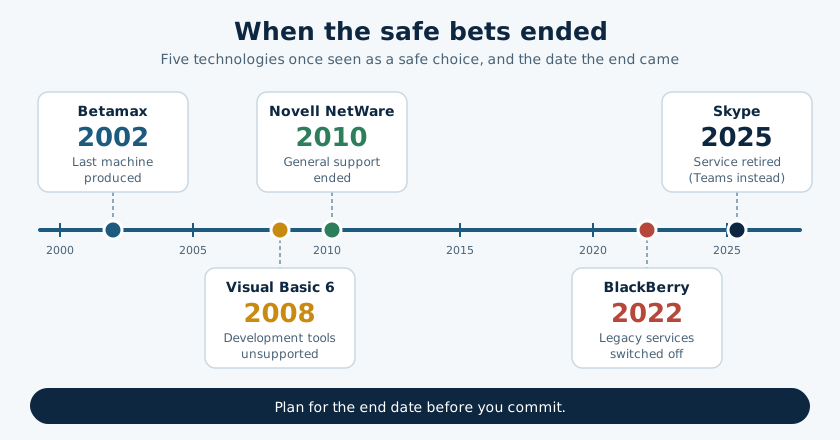
- Sort decisions into one-way and two-way doors. In his 2015 letter to shareholders, Jeff Bezos separated decisions that are hard to reverse from those that are not, and warned against using heavy process on the reversible ones. Most technology choices can be made reversible if you design them that way. Spend your rigour on the one-way doors, such as a platform that your data and processes will live in.
- Pay for flexibility early. Prefer open standards, portable data formats and well-defined interfaces, and avoid heavy customisation of anything you may need to leave. Put the cost of exit in the business case, alongside the cost of staying, and compare it with Option 0 (do nothing).
- Write the criteria down before you look at products, and involve the people who will use the technology. A decision that comes from a leader’s preference is a gamble with no odds attached.
- Set review triggers. Write down the events that would make you revisit the decision: the vendor is acquired, market share falls sharply, or support dates approach. Then diarise a review.
- Keep a second option alive. Keep at least a few people who understand the alternative. That is how organisations pivot quickly instead of starting from zero.
For developers
Choose the language for the problem, but invest your learning in what carries over: concepts, data structures, databases, networking, security and design. Frameworks come and go, and these do not. Being comfortable in two or three languages makes any one of them less of a bet.
For people building a career
My NetWare experience taught me three rules:
- Choose certifications that teach concepts as well as products, and ask what you would still know if the vendor disappeared.
- Bank your skills in stages. Each course should be useful on its own, not only as part of a 26-step path.
- Watch where your employer and the market are heading, and be ready to turn.
The same bet is happening with AI
Today’s AI market has the same features: fast change, many vendors and strong marketing. Choose tools your organisation can support, keep your data portable, and invest in the skills that transfer between tools, such as clear instructions and checking results, as I describe in AI is a junior colleague.

A note for Adelaide
In a smaller market with fewer local specialists, a bad technology bet hurts more. Skills are harder to hire and harder to replace, and mid-sized organisations and not-for-profits have less capacity to absorb a forced change. That is a reason to favour widely supported technologies with local support, and to keep your skills pipeline broad.
Adaptation and flexibility
Some organisations can pivot quickly and embrace new technology. That takes bold leadership, because it means gambling on an emerging player when the industry “standard” is still the comfortable choice. The leaders who do it well are not clairvoyant. They have kept their options open, they have people who understand the alternatives, and they make the decision with evidence, not preference.
History shows that picking the “best” technology is much harder than spotting the current leader. The technologies that became standards often won not because they were technically better, but because they built stronger ecosystems, reached more people, had better economics or arrived at the right time. So instead of trying to predict the single winner, individuals and organisations are better served by investing in adaptable skills, foundational knowledge and the ability to keep learning.
I see this in my capacity as “project rescue”, where I have made my career in recovering off-track projects and even entire IT functions. What I have learned is that whilst the underlying technology may change – because it is not a right fit for this situation – the people, the culture, the practices and the vision of the organisation are the real winners. Have a strong focus on people and direction, and the technology choices can become more flexible.
What technology bet have you won or lost? I would like to hear your war stories.
