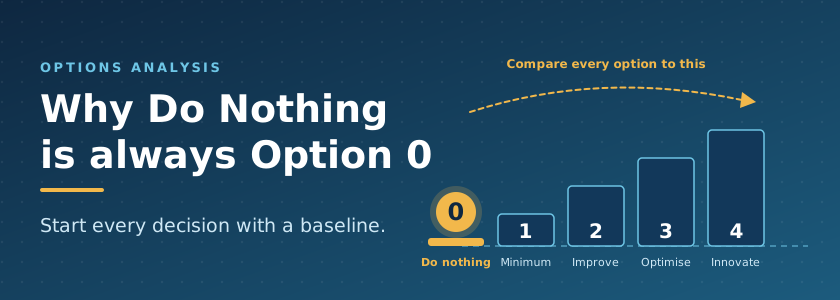
Every options analysis should start at Option 0: Do Nothing. It is the baseline that every other option is measured against, and it is the option most often left out. This is a bit of a longer article, because I have compiled a lot of my thinking to help with… Continue Reading Options analysis: why Do Nothing is always Option 0
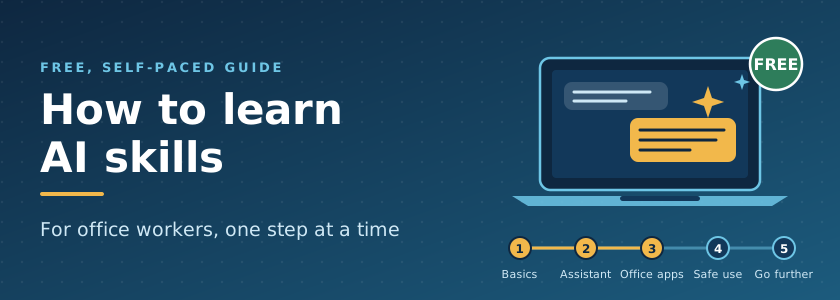
Most people learn to use AI by trial and error, and a lot of them do it with whatever free tool they found first. That works, up to a point. A little structured learning will get you better results, faster, and help you avoid the mistakes that cause real harm,… Continue Reading How to learn AI skills: a free, self-paced guide for office workers

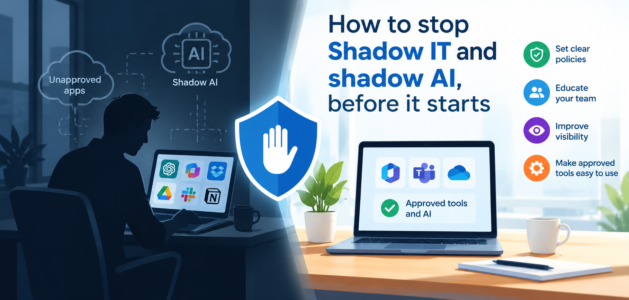
Shadow IT is rarely rebellion. It is a signal that someone has a problem to solve, and the official route did not solve it. I described what Shadow IT is, and what it costs, in Shadow IT / Stealth IT. This article looks at the other side: how to stop… Continue Reading How to stop Shadow IT before it starts

“Click the Start button at the bottom left of the screen.” “There is no Start button.” “It will be on the taskbar, at the bottom.” “My taskbar is on the left. And I have hidden it.” Anyone who has worked on a service desk has had that call. The user… Continue Reading Does Personalisation and Customisation make support and training more difficult?

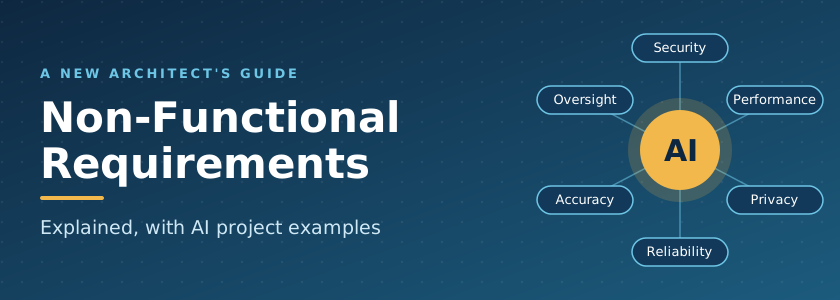
When a business asks for an AI solution, the request almost always describes what it should do. Summarise our emails. Draft our reports. Answer staff questions about policy. What it rarely says is how well, how quickly, how safely and at what cost. That second half has a name: non-functional… Continue Reading Non-functional requirements explained: a new architect’s guide, with an AI project example

This article outlines a strategic roadmap for organisations beginning on their digital transformation journey. It walks through the key phases – assessment, goal setting, pilot testing, scaling and covering cultural change and compliance – offering insights into aligning technology adoption with long-term business objectives. It emphasises change management and stakeholder… Continue Reading Digital Transformation Roadmap: From Legacy to Innovation

Even with the gradual increase in cybersecurity literacy amongst the masses, there are still some myths that people follow religiously, even Cybersecurity professionals. I will set out to bust some of those myths here. Many of the myths have come from companies advertising products as a “silver bullet” solution, some… Continue Reading Cybersecurity Myths – my home network is safe

Even with the gradual increase in cybersecurity literacy amongst the masses, there are still some myths that people follow religiously, even Cybersecurity professionals. I will set out to bust some of those myths here. Many of the myths have come from companies advertising products as a “silver bullet” solution, some… Continue Reading Cybersecurity Myths – phones are safe

Even with the gradual increase in cybersecurity literacy amongst the masses, there are still some myths that people follow religiously, even Cybersecurity professionals. I will set out to bust some of those myths here. Many of the myths have come from companies advertising products as a “silver bullet” solution, some… Continue Reading Cybersecurity Myths – I’m not a target

Creation of good policies and procedures is an art that can be helped with some core advice. Policies are the backbone of how a business tells their employees how to act and react, and ensures consistency and productivity. A great company culture, a consistent vision and values, and compliance with… Continue Reading Creating good policies and procedures

The English journalist Louis Theroux has a reputation for interviewing “difficult” and unusual people and subcultures, and getting a large amount of information and knowledge from people who otherwise do not open up to outsiders. The techniques and patterns that he uses to get people to open up are methods… Continue Reading Get information the Louis Theroux way

Cybersecurity is more than just firewalls and anti-virus, goes further than just zero-trust approaches and cultural changes, and is beyond just policy and compliance. Cybersecurity is not an ‘action’ or a ‘solution’ – it is an ongoing activity that needs constant review and updating. Cybersecurity Planning will vary for each… Continue Reading Cybersecurity planning

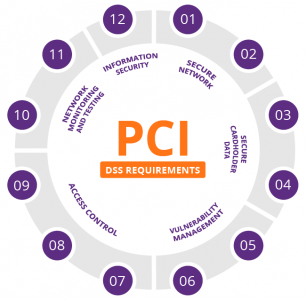
Last month, I wrote an article on the Essential 8. The article pointed out that for most of the measures, they should be the absolute minimum measures that organisations take with their systems. For those who work in the area of security, most of the Essential 8 are common-sense and… Continue Reading Obvious PCI-DSS benefits

Often misunderstood, but the concept of “design for failure” is now common in the lexicon of system design and business operations. When you design for failure, it is not because you want to fail – instead it is with the understanding that failures can and do happen, but you want… Continue Reading How to design for failures

In our ever-increasingly online lives, passwords have become a vital part of our existence. However, passwords are still the most vulnerable part of our security – because they are created and used by people, who persistently are the weakest point in any security protection. Why are passwords so easy to… Continue Reading Password tips for ease of use

We are frequently given advice on creating complex passwords, never re-using passwords, and setting up two factor authentication, but we need to consider the 2 factor authentication risks – which come about through both technology limitations and with the ever-present security weakpoint of human factors. What is 2FA? Firstly, it… Continue Reading 2 Factor Authentication risks

With the use of Software as a Service offerings increasing, with 99% of businesses projected to use one or more SaaS solutions in an industry that is worth $165Bn a year. There are 15,529 companies providing SaaS solutions , and so it seems like a logical choice to start using… Continue Reading Risks of SaaS

Does your organisation have a culture of cybersecurity? Or, is your company taking a ‘traditional’ approach with cybersecurity and considering it to be a layer that is applied by the IT department? The way that most modern organisations are evolving is that cybersecurity is a culture, not an action to… Continue Reading Cybersecurity is a culture, not an action